Here is how a lot of friendships end. Someone sends you a message. You read it, you cannot think what to say, so you leave it until you can. The longer you leave it, the more the reply needs to be good, to make up for the delay. After four days it needs to be a paragraph. After a week it is easier not to send anything at all.
Nothing went wrong between you. You just got stuck. This is about getting unstuck.
Why you get stuck
Usually one of three things. The message did not contain a question, so there is nothing to answer. You feel you need to match the other person's energy and cannot find it. Or you are tired, and a reply feels like a task rather than a pleasure.
All three have the same fix: lower the bar for what counts as a reply.
A reply can be very small
A reaction is a reply. A heart, a laugh, a thumbs up says "I read this and I'm here", and it keeps the thread alive with no words at all. Three words are a reply. "Ha, that's great" is enough. The other person is not grading you. They want to know you are still there.
If you are thinking "but that's not a proper answer", notice that a proper answer is what has been stopping you.
Lines that work when you are stuck
For a message with no question in it:
- "That sounds good. What did you make of it?"
- "I don't know much about that, tell me more."
- "Same here, honestly." Then one detail.
For when you have nothing:
- "I don't know what to say to that, but I'm glad you told me."
- "I'm a bit flat today. Can I come back to this tomorrow?"
- "Sorry for the slow reply, I'm here." No explanation needed.
For restarting after a gap:
- "I went quiet, that was me, not you. How's the week been?"
- Send a question about something they mentioned before. Remembering is the warmest thing you can do.
End your messages with a question
This is the single most useful habit. A message that ends in a full stop hands the other person a blank. A message that ends in a question hands them something to answer. "Good weekend, went for a walk" stops the conversation. "Good weekend, went for a walk. Did you get out at all?" keeps it going, and now the pressure is shared.
Share something small instead of saying something
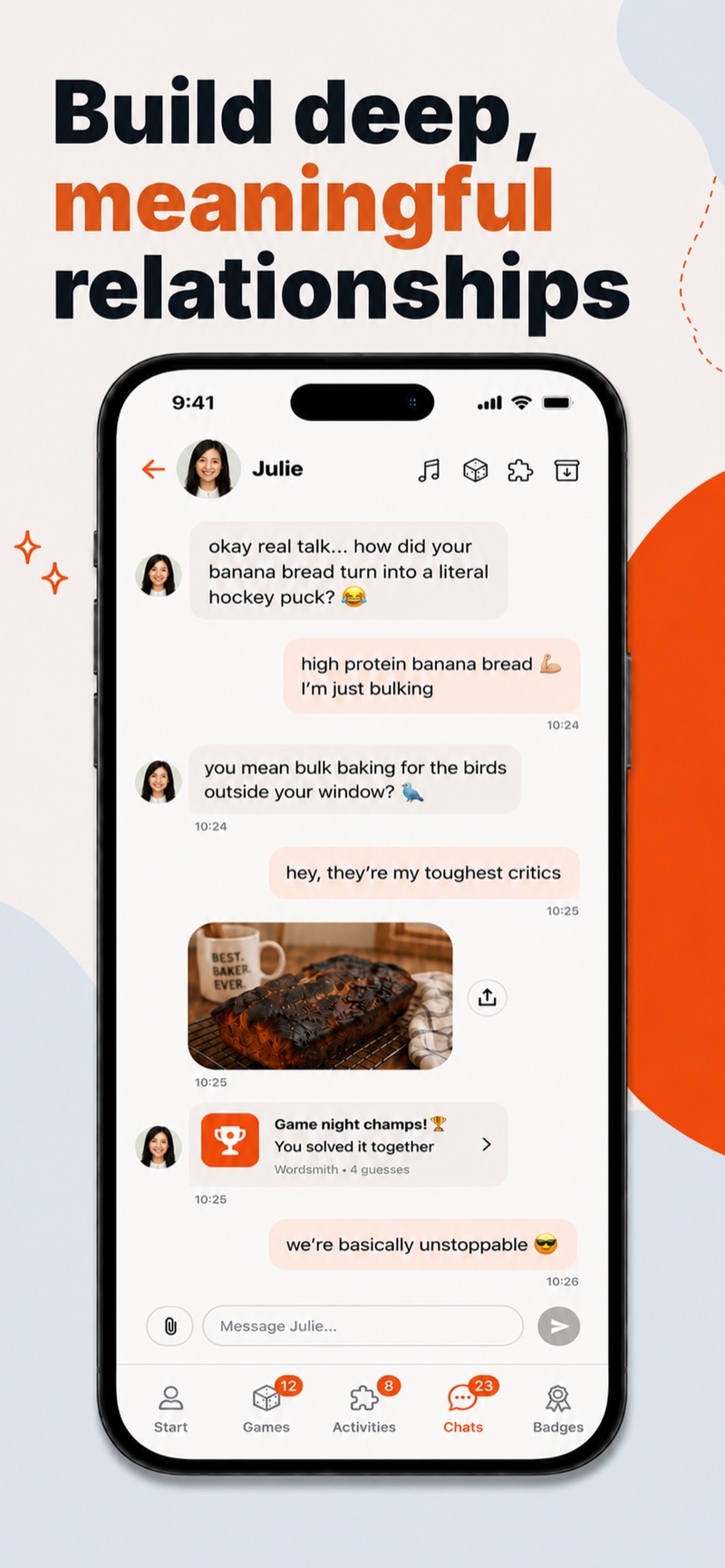
A photo of what you are cooking. A song you have on. The game you are playing. These are messages that do not need words, and they often start better conversations than words would. Most of our members' conversations start from a shared photo or a game, not from a sentence.
Why we built the app this way
We make The Pebble Club, a free friendship app for autistic adults, and the whole thing is designed around the problem above. A game move counts as contact, so you can keep a friendship going for a week without typing a word. There are question prompts you both answer in private before either of you sees the other's reply, so there is always something to answer and nobody goes first. And there is no "last seen" and no timer, so replying tomorrow is normal rather than rude.
Give yourself the same grace
If the other person goes quiet, assume they are stuck, not gone. Send something small. If you go quiet, come back without the apology spiral. "I'm back, hello" is enough. Friendships survive gaps far better than you think; what they do not survive is the belief that a gap has to be explained.
If you would like a list of questions for when you are stuck, we have one: questions to ask a new friend that aren't small talk. And the app is free on the App Store and Google Play, with more at thepebbleclub.com.