"How was your weekend?" is supposed to be the easy question. For a lot of autistic people it is the hardest one in the conversation, because it is not really a question. Nobody wants the actual answer. They want a signal: I am friendly, I am available for conversation, your turn. If you answer it literally, you have already got the rules wrong, and you can feel it.
That is small talk. It is a set of moves with hidden purposes, and the purposes are the bit nobody explains.
What small talk is actually for
Strip it down and small talk does three jobs. It signals that you are safe and friendly. It checks whether the other person wants to talk. And it buys time while both of you decide whether to go further.
Those are all reasonable jobs. The problem is that the vehicle for them, a pretend conversation about the weather and the weekend, is one where the words do not mean what they say. Autistic people tend to process words as meaning what they say. So we answer the question, or we freeze because we can tell there is a layer we cannot see, or we rehearse so hard that we miss our turn.
Knowing what the jobs are helps, because you can do them another way.
Three ways to do the jobs without the ritual
Say the quiet part out loud. "I'm not great at small talk, but I'd like to talk to you. What are you into?" does all three jobs in one go and it is disarming. Most people find it a relief.
Lead with a real question. "What are you reading at the moment?" or "what's the best thing you've watched this year?" is friendly, checks their interest, and goes somewhere. We have collected questions to ask a new friend that aren't small talk.
Do something, then talk. This is the big one. Play a game, build something, walk somewhere. The activity does the signalling for you. You are both there, so you are both friendly and available. The conversation that happens around an activity is about the activity, which is real, and it has gaps in it that nobody has to fill.
Why we built an app around this
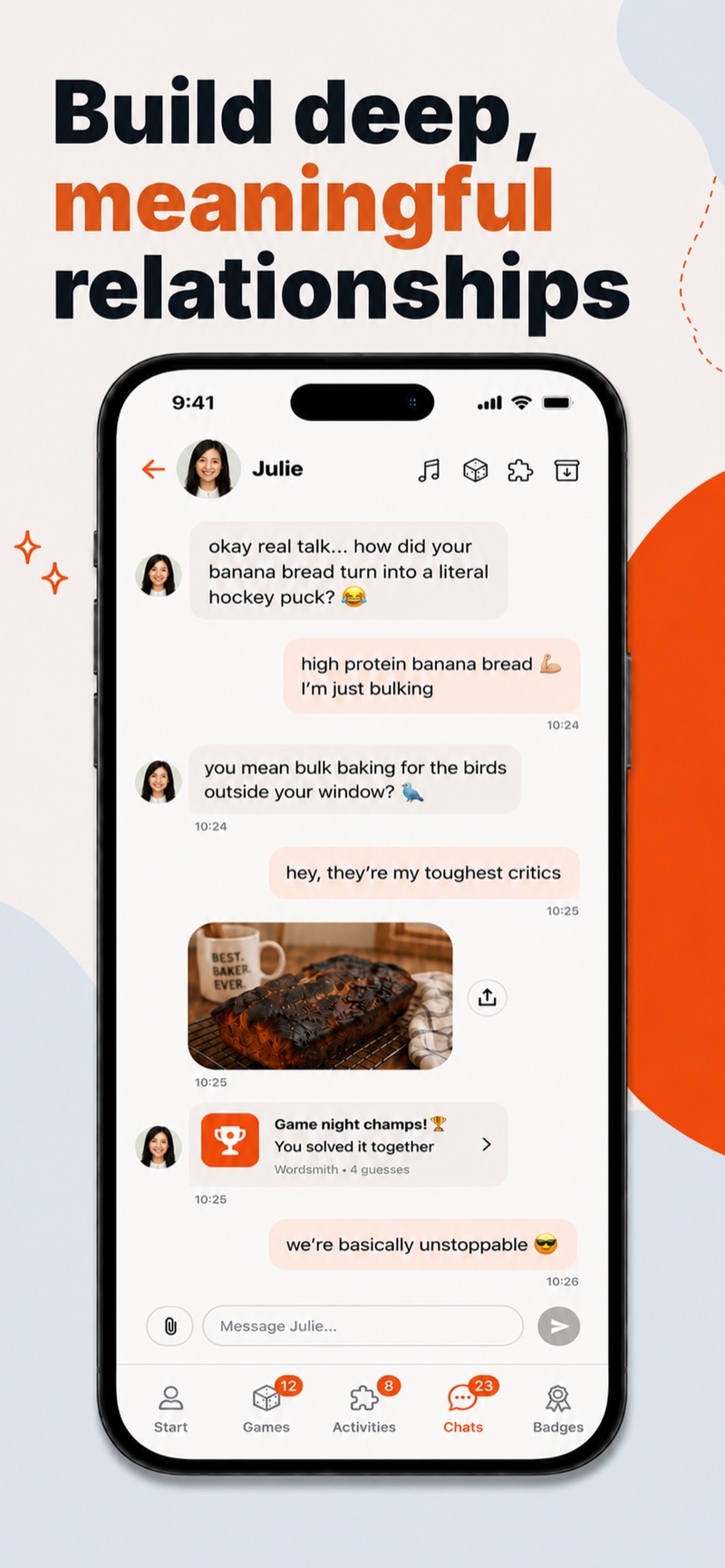
We make The Pebble Club, a free friendship app for autistic adults, and the whole design comes from the third idea above. When you are matched with someone, you do not get a blank chat. You get a game: Chess, Connect 4, Battleships, a jigsaw you build together, a word puzzle you crack as a pair. The first thing you ever say to each other can be about the game, or you can say nothing for a week and just play. Then there are question prompts you both answer in private before either of you sees the other's reply, so nobody has to go first and nobody is left hanging.
It is small talk with the small talk removed.
If you are stuck in a small-talk conversation
A few lines that work:
- "I'm going to skip the small talk if that's okay. Tell me something you're actually excited about."
- Answer briefly, then ask your real question. "Good thanks. Can I ask what you do when you need to switch off?"
- If it is text, send a question with your reply so the other person has something to answer. A reply that ends in a full stop ends the conversation; a reply that ends in a question keeps it going.
And if you simply cannot do it today, that is allowed too. "I'm a bit flat today, can we pick this up tomorrow?" is honest, and the people worth knowing will say yes.
There is more about how the app works at thepebbleclub.com, and it is free on the App Store and Google Play.