If you search for a friendship app for autistic adults, you get a strange mix: news stories from years ago, a couple of app store pages with a handful of reviews, and a lot of dating apps that have bolted a "friends" mode on the side. It is hard to tell what still exists, what is free, and what is actually for you.
This is our attempt at a straight answer. We make one of these apps, so read the last section with that in mind. We have tried to be fair about the others.
Why most apps don't work for autistic people
The standard friendship app copies dating apps: a photo, a short bio, swipe left or right, then an empty chat box.
- You are judged on a photo and a bio, which is a small-talk contest before anything has happened.
- Once matched, you are expected to start a conversation from nothing, and to reply quickly.
- The feed, the streaks and the little counters are designed to keep you checking, which for a lot of us means anxiety rather than fun.
- Nothing in them gives you a reason to talk, so the conversation dies at "how's your week going".
So the first thing to know is that if these apps have not worked for you, the apps are the problem, not you.
What to look for
Before the list, here is what we would check on any app:
- Is there something to do? A game, a question, a shared activity. Anything that means you are not staring at a blank chat.
- Can you go at your own pace? No timers, no "last active" shaming, no penalty for replying tomorrow.
- Is it clear what the app is for? Friendship only, or friendship and dating mixed together? Mixed apps attract people looking for dates, whatever box you tick.
- What happens when someone is unkind? Look for blocking, reporting and rules that are actually written down.
- What does it cost, really? Free to download often means free to look and paid to talk.
- Who is on it? A beautifully designed app with nobody in your country is no use. New apps are honest about this if you ask.
The apps made for autistic people
Hiki is the best known. It is an American app for autistic adults that covers both dating and friendship, and it has had press coverage since it launched. The mix of dating and friendship is the thing to think about: if you only want friends, you will be sharing the app with people who want more than that.
Making Authentic Friendships was built by a sister for her brother, who is autistic and has ADHD. It is for people with a range of disabilities rather than autism specifically, and it matches on age, diagnosis, interests and location. It is mostly used in the United States, so check whether there is anyone near you.
Autistic Empathy is an iPhone-only app for adults who identify as autistic, run by autism-specialist counsellors with a helpline attached. It has a small number of reviews, which usually means a small number of members.
With all three, we could not confirm current pricing or how active they are in the UK. Check the app store listing and the date of the last update before you download.
General apps that can work
Bumble BFF is the friend mode of the dating app. It has by far the most people, which is its strength and its weakness: lots of profiles, lots of swiping, and lots of chats that go nowhere. If you are good at starting conversations it can work. If you are not, it is the blank-chat problem at scale. We wrote more about this in apps like Bumble BFF for people who hate the swiping part.
Meetup is not a friendship app, but it lists real groups, including autism social groups in most big cities, and you get to meet people over an activity rather than a chat box. The downside is that it is in person, which is not everyone's starting point.
Discord and forums are where a lot of autistic adults actually make friends. Wrong Planet has been running since 2004, Autism Forums is active, and there are Discord servers for autistic adults in most countries. They are conversations in groups rather than one-to-one, which some people find easier and some find harder.
Local groups are still the most reliable route for many people. The National Autistic Society's directory lists social groups by area, and we have put together a list of autism social groups for adults in London.
The Pebble Club
This is ours, so weigh it accordingly. The Pebble Club is a free app for autistic adults, on iPhone and Android, built around the first thing on the checklist above: there is always something to do.
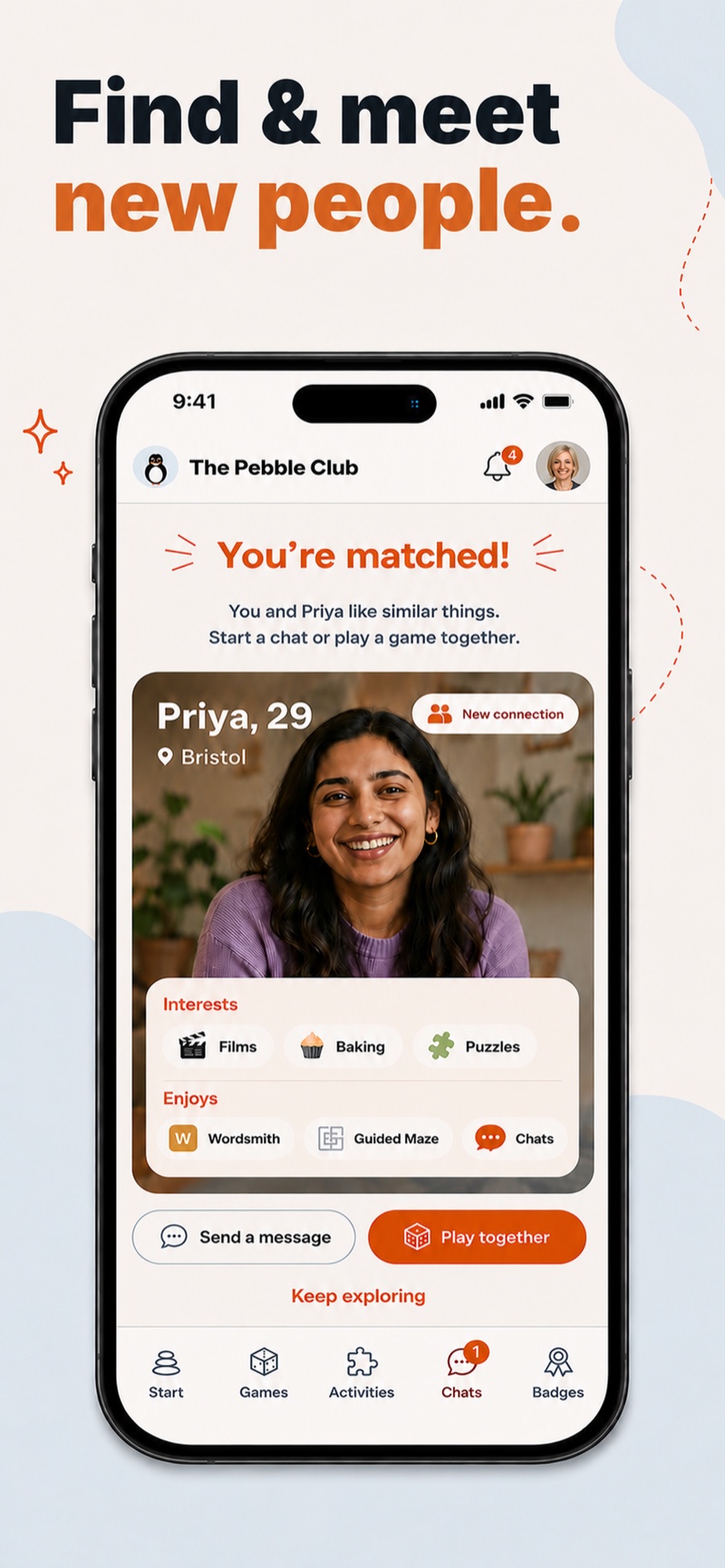
You are matched with someone who shares your interests. Then, instead of a blank chat, you play a game together: Chess, Connect 4, Battleships or Noughts and Crosses a move at a time, or a jigsaw, a nonogram or a word puzzle you solve as a pair. There are question prompts you both answer in private before either of you sees the other's reply, so nobody has to go first. Conversation grows out of all that, when you are ready.
There is no swiping, no feed and no likes. Everything is turn-based, so replying tomorrow is normal. Everyone agrees to the same five rules before they can speak to anyone, and blocking and reporting are built in. It is for adults only.
The honest part: it launched in September 2026, so it is small. If you join today you will find real people, but not thousands of them.
A note on safety, whichever app you pick
Use a first name only until you know someone. Keep money out of it completely; anyone who asks for money is not a friend, however long you have been talking. Meet in public places if you meet at all, and tell someone where you are going. And use the block button without feeling bad about it. It exists so you do not have to explain yourself.
If you want to try ours, it is free on the App Store and Google Play, and there is more about how it works at thepebbleclub.com.