
Should you try Synchrony or The Pebble Club to make friends as a neurodivergent adult?
In short: both are friendship-first apps for adults, matched on shared interests, but they work differently. Synchrony is US-only, open to anyone who identifies as neurodivergent, checks every member through a trusted reference, and offers an optional AI coach called Jesse when you are stuck in a conversation. The Pebble Club is made for autistic adults, works anywhere, and starts every friendship with a game or puzzle instead of a chat. Both are young and small. We make The Pebble Club, so weigh our view and check the facts below. Last checked 20 November 2026.
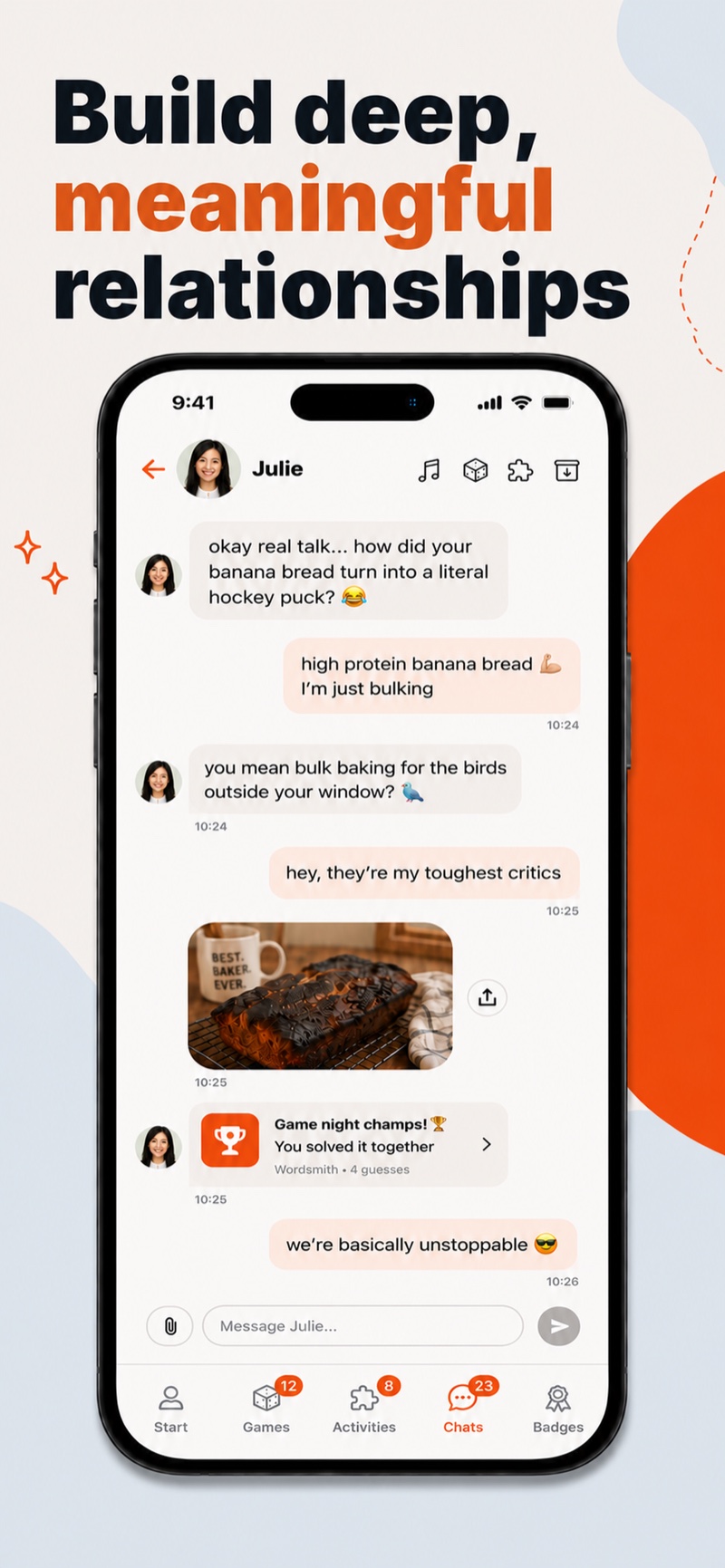
Synchrony launched on the App Store in February 2026 and has had a lot of press since, including ABC News, Fast Company and TechCrunch. If you have seen it mentioned and wondered how it compares with other apps for autistic and neurodivergent adults, this guide is for you.
Where Synchrony does something better, we say so plainly.
Synchrony and The Pebble Club at a glance
| Synchrony | The Pebble Club | |
|---|---|---|
| What it is for | Friendship and community first; some members may form "deeper relationships" | Friendship only |
| Who can join | Adults 18+ in the US who identify as neurodivergent (autism, ADHD, OCD, anxiety and more); no diagnosis needed | Autistic adults 18+ |
| Where | United States only | Anywhere; online only |
| How you meet people | Matched ("synced") with people who share hobbies, interests, preferences and communication styles | Matched on shared interests; you start with a game or puzzle together |
| First contact | You choose which Sync Mates to chat with | A game, a shared puzzle or a question prompt; chat is there when you want it |
| Help with conversations | Jesse, an optional AI social coach | Games, question prompts and a question of the day |
| Joining checks | A trusted reference confirms who you are; optional photo ID and selfie check | Date of birth checked at sign-up; no ID or reference |
| Profile | Clear recent photo plus 2 or 3 more, first name and last initial, age, city and state | First name, a line about you, interests and a photo or avatar |
| Cost | No charge during its launch period; a subscription after that | A paid membership with no ads; prices are in the app |
| Platforms | iPhone and Android | iPhone and Android |
| Running since | February 2026 | September 2026 |
What Synchrony is
Synchrony calls itself "a social connection app exclusively for neurodivergent adults (18+) in the U.S." Its FAQ (joinsynchrony.com/faq) says it is "designed first and foremost to help neurodivergent adults build friendships and meaningful community," while some members "may naturally form deeper relationships over time." Its homepage puts it more broadly: "Whether you're looking for friendship, romance, or are just exploring, we'll help you connect." So it is friendship first, but not friendship only.
Synchrony was co-founded by Jamie Pastrano, a licensed social worker with a PEERS certification from UCLA and the mother of an autistic son, and Rebecca Matchett, an entrepreneur. Both are based in New York City. Its team page also lists an autism specialist and an autistic researcher and consultant. The company behind it is Synchrony Productions, LLC. It is not the Synchrony Bank app, which is worth knowing because searching "Synchrony app" mostly brings up the bank.
You do not need a diagnosis to join. Synchrony says it is "for any person whose brain processes information differently, including people with ADHD, OCD, anxiety, or other neurodivergent experiences."
How joining works: the trusted reference
This is the thing that makes Synchrony different from every other app in this space. Before you finish your profile, you send a short request to a "trusted reference." That can be a family member, employer, coworker, provider or anyone you are comfortable asking. They confirm their relationship to you, that you are who you say you are, and that Synchrony is a good fit for you. They do not need an account. Once they reply, you can start connecting. Synchrony is clear that this is not a background check. It is there to keep the community made up of real people.
There is also an optional identity check. You upload a photo of a government ID and take a selfie, which is processed by a third-party company called Persona. Synchrony says the images are discarded afterwards. If you do it, you get an "Identity checked" badge. If you do not, you still have full access.
For some people the reference step is reassuring, because everyone you meet has been vouched for by someone. For others it is a barrier, especially if you do not have someone you feel comfortable asking, or you would rather your family did not know which apps you use.
How meeting people works on Synchrony
Once you are verified, you build your profile and Synchrony's matching "syncs" you with people who share "similar hobbies, interests, preferences and more." Its profiles include categories for hobbies and activities, special interests, communication preferences, relationship goals and social comfort levels. You choose which Sync Mates to chat with, at your own pace. Synchrony says it will send "gentle reminders about new connections or messages, but there's no pressure to perform."
Its community guidelines (joinsynchrony.com/community-guidelines) ask for a clear photo of yourself taken within the last six months, two or three more photos of daily life, your first name and last initial, your age, and your city and state. They also give advice for meeting in person, such as choosing public places for at least the first three meetings, which tells you Synchrony expects some friendships to move offline.
Jesse, the AI coach
Synchrony's other distinctive feature is Jesse, an optional "AI-supported, on-demand social coach." If you open it while you are stuck, Jesse reads your recent conversation and suggests ideas for what to do next. It can help with keeping a conversation going, understanding what someone meant, or protecting a boundary. Synchrony is careful to say that Jesse never starts on its own, never talks to you about anything else, and never sends messages for you. If you have wished for someone to ask "what did they mean by that?", this could be genuinely useful. If you would rather not have AI anywhere near your conversations, you can simply never open it.
What it costs
Synchrony's pricing page (joinsynchrony.com/pricing) says membership has no charge during its launch period, and that after that it will move to a subscription, with one-month, three-month and six-month plans. Its App Store listing says it "requires the purchase of a subscription after a free trial period." Synchrony says the paid model means no advertising and no selling of data. Prices are on its pricing page if you want them.
Safety on Synchrony
Beyond the reference and the optional ID check, Synchrony uses "both human moderation and automated tools." You can report members in the app, and its guidelines set out what happens next. First or minor problems get a warning, serious or repeated ones get a 30-day suspension, and severe ones lead to a permanent ban. Synchrony also notes that it "does not conduct background checks" and that members are responsible for their own safety when meeting.
What members say
Synchrony is young, so there are few reviews to go on. On the App Store it shows 4.2 out of 5 from 19 ratings. On Google Play it shows 2.7 out of 5 from 7 ratings and more than 500 downloads. Its app version is 0.3.5. Numbers that small do not tell you much either way, except that it is still early.
What The Pebble Club is
The Pebble Club is a friendship app for autistic adults, on iPhone and Android. It launched in September 2026. It is not a dating app, and it works the same wherever you live.
Instead of looking at profiles and starting a conversation from nothing, you do something together. You are matched with someone who shares your interests, and you can start with a game of Chess, Connect 4, Battleships or Noughts & Crosses (tic-tac-toe), played a move at a time. Or you can solve something as a pair. You might play Wordsmith, a word game where you take turns, or work on a Mystery Picture Puzzle or a jigsaw, or try the Guided Maze, where one of you guides and the other walks. There is more on why this helps in turn-based games to play with a friend online.
Talking is there whenever you want it. Question prompts are answered privately by both of you before either sees the other's answer, so nobody has to go first. There is a question of the day, and a space called Corner where the club shares answers, photos and what people are into, and you can reply privately to anyone whose post you like. On mornings when you have nobody to talk to yet, the app introduces a suggested friend with interests like yours. Chat works like any messenger, with photos, voice notes, replies and reactions.
There is no swiping, no endless feed, no like counts, no streaks and no timers. Everything is turn-based, so replying tomorrow is normal. You can archive a chat without drama, and nobody is ever told you said no.
Everyone agrees to the same five rules before they can speak to anyone. Members agree to be kind, never to be abusive, to respect boundaries and never pressure anyone, to keep it appropriate (no sexual content, requests for money or spam), and to look out for each other. Every conversation and game has a block and report control. Blocking is silent, and a person reads every report within 24 hours.
The Pebble Club is a paid membership with no ads, on a weekly or annual plan, with a trial on the annual plan. Prices are shown in the app before you choose.
Where Synchrony is the better choice
Synchrony is likely to suit you better if:
- You want to know everyone has been vouched for. The trusted reference means every member has someone who confirmed they are real. The Pebble Club checks age at sign-up but has no reference or ID step.
- You would like help in the moment. Jesse can look at a real conversation and suggest what to say next or what someone might have meant. The Pebble Club helps you start conversations, with games and prompts, but it does not coach you through them.
- You hope to meet friends in person. Synchrony is US-only and asks for your city and state, and its guidelines include advice for meeting up. The Pebble Club is online only and never matches you by location.
- You are neurodivergent but not autistic. Synchrony welcomes ADHD, OCD, anxiety and other neurodivergent experiences. The Pebble Club is made for autistic adults.
- You want to try it without paying yet. Synchrony has no charge during its launch period. The Pebble Club is a paid membership.
- You might want more than friendship later. Synchrony is friendship first but open to romance. The Pebble Club is friendship only.
- The people who built it matter to you. Synchrony's founders bring social work and PEERS training, and its team includes an autism specialist and an autistic advisor.

Where The Pebble Club is the better choice
The Pebble Club is likely to suit you better if:
- Blank chats are the hard part. On Synchrony, you choose a Sync Mate and start chatting, with Jesse in reserve. On The Pebble Club you start with a move in a game, so there is something to do before there is anything to say. If small talk is what wears you out, read autism and small talk.
- You do not want to ask anyone for a reference. Joining The Pebble Club does not involve anyone else.
- You would rather keep AI out of it. Jesse is optional, but if you prefer an app with no AI coach at all, ours has none.
- You live outside the US. Synchrony is currently US-only. The Pebble Club works wherever you are.
- You would rather not share your city, extra photos or last initial. Synchrony's guidelines ask for several photos, your last initial and your city and state. The Pebble Club asks for a first name, a line about you, your interests and a photo or one of its avatars, and only shows other members your age band.
- You want friendship only. There is no dating on The Pebble Club, so nobody is there looking for something else.
- Games are your thing. If chess, Battleships or a shared jigsaw sounds like a better first hour than a chat, The Pebble Club was built for you.
How the two compare on the things that matter most
Starting a conversation
Both apps match you on interests, which is a good start. The difference is what comes next. Synchrony puts you in a chat and offers a coach if you want help. The Pebble Club puts you in a game, and the conversation grows out of it. Neither approach is wrong, and they suit different people. If the blank chat box has defeated you before, you might like what to say when you don't know what to say.
Pace and pressure
Both say you can go at your own pace. Synchrony sends gentle reminders about new connections and messages. The Pebble Club has no timers and nothing expires, and declining a game is invisible to the other person.
Trust and safety
Synchrony's reference check is the strongest joining check of any friendship app we know of for neurodivergent adults, and its optional ID check adds more. The Pebble Club relies on rules everyone agrees to before speaking, a block and report control on every conversation and game, a person reading every report within 24 hours, and automatic blocking of requests for money or contact details where we can spot them. The same advice holds on either app. Use only your first name until you know someone, never send money, meet in public if you meet at all, and block people without guilt.
Privacy
Synchrony says it does not sell data and discards ID check images after the check. The Pebble Club never shows your date of birth, only an age band, and keeps any description of your neurodivergence private. Both privacy policies are worth reading in full. Synchrony's privacy policy is at joinsynchrony.com/privacy-policy, and you can read ours here.
Cost
Synchrony has no charge for now and will move to a subscription after its launch period. The Pebble Club is a paid membership with a trial on the annual plan. Check both apps for current prices before you decide.
Can you use both?
Yes. If you are in the US, there is nothing stopping you trying Synchrony while it has no charge, and using The Pebble Club for slow friendships that start with a game. They are different enough that they do not really compete for your evenings.
For the wider field, see our guide to friendship apps for autistic adults. We have also compared The Pebble Club and Hiki, the largest app for neurodivergent adults, which covers dating as well as friendship.
How to decide in five minutes
- Do you live outside the US? Then Synchrony is not available to you yet.
- Does knowing everyone was vouched for matter most? Try Synchrony.
- Would a coach for tricky conversations help? Try Synchrony.
- Is starting the conversation the hardest part? Try The Pebble Club, where a game does the starting.
- Are you autistic and want friendship only, one person at a time? That is what The Pebble Club is for.
Whichever you pick, give it a few weeks before you judge it. Small, new apps take time to fill up, and friendships take time too. When one starts, our list of questions to ask a new friend can help keep it going.
Synchrony is on the App Store and Google Play (US only). The Pebble Club is on the App Store and Google Play.