
Is Hiki or The Pebble Club better for making friends as an autistic adult?
In short: they are built for different things. Hiki is the biggest and longest-running app for neurodivergent adults, with friendship and dating side by side, a community feed, group chats and filters for distance, so it suits you if you want a large crowd, a social feed, or a partner as well as friends. The Pebble Club is friendship only, one person at a time, and every friendship starts with a game or a puzzle instead of a blank chat. It is new and much smaller. We make The Pebble Club, so weigh our view, and check the facts below yourself. Last checked 20 November 2026.
A lot of people search for a Hiki review and find a mix of Reddit threads, old press releases and app store comments, some glowing and some furious. That is not much help if you are trying to decide whether to download it.
This guide puts Hiki and The Pebble Club side by side. Where Hiki does something better, we say so.
Hiki and The Pebble Club at a glance
| Hiki | The Pebble Club | |
|---|---|---|
| What it is for | Friendship, dating and community | Friendship only |
| Who can join | Adults 18+ who identify as neurodivergent: autistic, ADHD, AuDHD and more, diagnosed or self-identified | Autistic adults 18+ |
| How you meet people | Profiles in a match queue; tap Heart (romantic) or Smile (friendship) on a profile, or X to pass | Matched on shared interests; you start with a game or puzzle together |
| First contact | Chat opens after you both Like each other; you can send one custom message with your Like | A game, a shared puzzle or a question prompt; chat is there when you want it |
| Groups | Community page with posts and comments, plus group chats | None: one person at a time, never a group chat |
| Location | Matches can be filtered by distance | Matching ignores location; online only |
| Verification | ID verification; a verified badge for Premium members | Date of birth checked at sign-up; no ID check |
| Cost | Joining has no charge; Hiki Premium, Sparks and Boosts are paid extras | A paid membership with no ads; prices are in the app |
| Platforms | iPhone and Android | iPhone and Android |
| Running since | 2019 | September 2026 |
| Size | Says "nearly 200,000+" active users worldwide | New and small |
What Hiki is
Hiki describes itself as "a friendship and dating mobile app for the Autistic, ADHD, and all Neurodivergent community." It was founded in 2019 by Jamil Karriem, and its FAQ says all of Hiki's team members are neurodivergent. That matters to a lot of people, and it shows in some of the details. You never have to prove a diagnosis, and Hiki Premium lets you describe your neurodivergent traits, support needs and communication preferences on your profile.
Hiki is for anyone 18 or over who identifies as neurodivergent, "including professionally diagnosed, self-identified, or those exploring a neurodivergent identity." Its store listing names autistic, ADHD, AuDHD, Tourette's and dyslexic people among others, and it is openly LGBTQIA+ friendly.
How meeting people works on Hiki
You build a profile and see other people's profiles in a match queue. Next to each section of someone's profile there is a Heart and a Smile. The Heart means romantic interest, and the Smile means friendship. An X skips that person, and they come back into your queue again in a few days. A private chat opens only once you have both sent each other a Like, which Hiki calls "dual-party consent," and every member can send one custom first message along with a Like.
If you only want friends, you can say so in your Match Preferences, where you also set the age, distance and gender of the people you see. In its latest update (4 November 2026) Hiki made distance filtering available to everyone and increased the number of Likes you can send each day without paying.
The community side
Hiki is more than a match queue. Its store listing describes a community page where you can "post, react, comment, and engage," and its safety page mentions creating group chats with your favorite Hiki friends. Recent updates added voice messages and a setting that controls GIF autoplay across posts and chats. If you like the feel of a social network made only of neurodivergent people, this is where Hiki is strongest.
What is paid on Hiki
Joining Hiki has no charge, and Hiki says 99% of the app is open to everyone. The rest is in Hiki Premium. Premium includes a verified profile badge, seeing everyone who has Liked you, the profile fields for neurodivergent traits and communication preferences, video messages, answering prompts with audio or video, and seeing new profiles in other cities. Sparks (to show strong interest) and Boosts (to put your profile first in the queue for a while) are bought separately as in-app purchases.
Hiki also runs a program called Hiki for Everyone, which takes more than half off Premium. There is no application and no proof needed. It is open to people who are unemployed or underemployed, receive disability benefits, live with family or roommates, are raising disabled children, or identify as BIPOC or 2SLGBTQIA+. That is a genuinely kind piece of design, and we have not seen another app do it.
Hiki says it has never sold members' data and is funded by Premium and in-app purchases.
Safety on Hiki
Hiki says it uses ID verification to filter out scammers and underage users, that its administrators look for suspicious users daily, and that its moderation team reviews every report, with muting and temporary or permanent bans for people who break the rules. Premium members get ID verification and a badge now. Hiki's FAQ says free members will have ID verification on their profiles "soon." You can block or report anyone from the "..." menu or from the bottom of their profile.
What members say
On the App Store, Hiki has an average of 3.9 out of 5 from about 2,600 ratings. On Google Play it shows 3.5 out of 5 from about 4,000 ratings and more than 100,000 downloads. Reviews are mixed in the way you would expect for an app this size. Many people say it is the first place they have felt understood. Others are frustrated by how few people are near them, by profiles they think are fake, or by features behind Premium. Hiki itself is open about the first point. Its listing says, "Don't be discouraged if your city has yet to discover the magic of Hiki."
What The Pebble Club is
The Pebble Club is a friendship app for autistic adults, on iPhone and Android. It launched in September 2026. It is not a dating app.
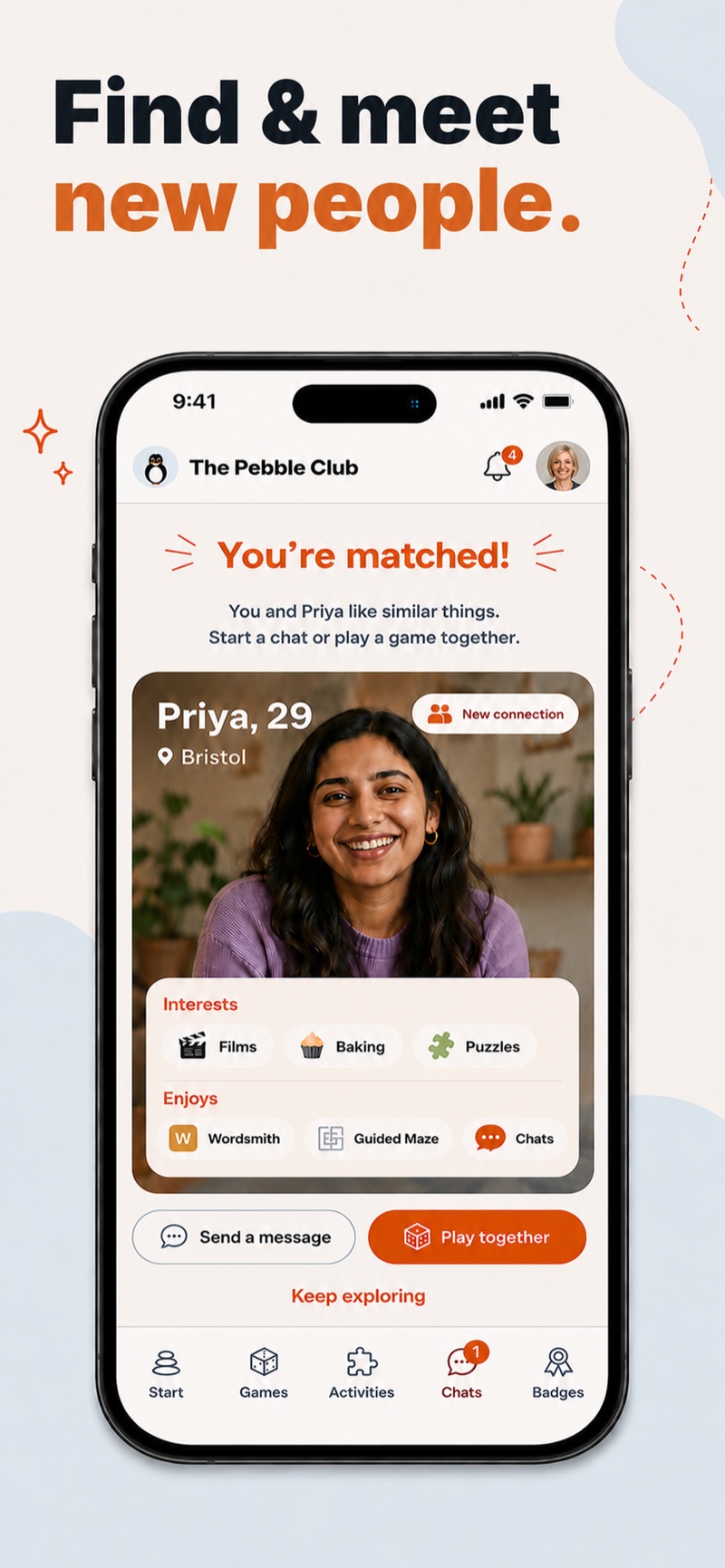
The idea is simple. Instead of looking at profiles and trying to start a conversation from nothing, you do something together. You are matched with someone who shares your interests, and you can start straight away with a game of Chess, Connect 4, Battleships or Noughts & Crosses (tic-tac-toe), played a move at a time. Or you can solve something as a pair. You might play Wordsmith, a word game where you take turns, or work on a Mystery Picture Puzzle or a jigsaw, or try the Guided Maze, where one of you guides and the other walks. We wrote more about why this works in turn-based games to play with a friend online.
Talking is always there but never required. There are question prompts you both answer privately before either of you sees the other's answer, so nobody has to go first. There is a question of the day, and a space called Corner where the club shares answers, photos and what people are into. You can reply privately to anyone whose post you like. Chat itself works like any messenger, with photos, voice notes, replies and reactions.
Some things are left out on purpose. There is no swiping, no endless feed, no like counts, no streaks and no timers. Everything is turn-based, so replying tomorrow is normal. You can archive a chat without drama, and nobody is ever told you said no.
Everyone agrees to the same five rules before they can speak to anyone. Members agree to be kind, never to be abusive, to respect boundaries and never pressure anyone, to keep it appropriate (no sexual content, requests for money or spam), and to look out for each other. Every conversation and game has a block and report control. Blocking is silent, and a person reads every report within 24 hours.
The Pebble Club is a paid membership with no ads, on a weekly or annual plan, with a trial on the annual plan. Prices are shown in the app before you choose.
Where Hiki is the better choice
We would rather you find the right app than download ours for the wrong reasons. Hiki is likely to suit you better if:
- You want to date as well as make friends. The Pebble Club is friendship only. Hiki was built for both, and it lets you signal which one you mean with every Like.
- You want to meet people near you. Hiki has distance filters and matches partly on location, so if there are members in your city you can find them. The Pebble Club ignores location on purpose and is online only.
- You want a crowd. Hiki has been running since 2019 and says it has nearly 200,000 active users worldwide. The Pebble Club is new and small, and we would rather say so.
- You enjoy a social feed and group chats. Hiki's community page and group chats are a real strength if you like being part of a busy space. The Pebble Club has no group chats and no public feed with likes.
- You do not want to pay to start. You can join Hiki and use most of it without paying. The Pebble Club is a paid membership.
- You are neurodivergent but not autistic. Hiki welcomes every kind of neurodivergence. The Pebble Club is made for autistic adults.
- You want ID verification. Hiki verifies Premium members' IDs and is bringing it to everyone. The Pebble Club checks age at sign-up but does not ask for ID.

Where The Pebble Club is the better choice
The Pebble Club is likely to suit you better if:
- Blank chats are the hard part. If you have matched with people before and then had no idea what to say, starting with a game removes that moment. You always have something to do, and the conversation can grow out of it. Our guide to autism and small talk explains why this matters.
- You only want friends. Hiki lets you set friendship only, but it shares the app with people who are there to date. The Pebble Club has no dating at all.
- You find feeds and counters stressful. The Pebble Club has no public like counts, no streaks and no endless scrolling, and nothing on it flashes or nags.
- You prefer one person at a time. Every conversation on The Pebble Club is one to one. There is no group chat to keep up with.
- You want to go slowly. There are no timers and nothing expires. Declining is invisible to the other person.
- There is nobody near you anyway. If you live somewhere small, a location-based app may show you very few people. Online-only matching means your matches are chosen by interests, not by distance.
How the two compare on the things that matter most
Starting a conversation
This is the biggest difference. On Hiki, once you match, you are in a chat, and you can also send a first message with your Like. If you are comfortable writing an opening line, that is quick and direct. On The Pebble Club, the first thing you do together is usually a move in a game, so the "what do I say?" problem mostly goes away. If that problem is why other apps have not worked for you, see what to say when you don't know what to say.
Pace and pressure
Both apps say you can go at your own pace. Hiki has a match queue and daily Likes, and paid Boosts and Sparks to get noticed faster. Some people find that motivating and others find it stressful. The Pebble Club has no queue to work through and nothing to speed up, and turns wait until you are ready.
Sensory load
Hiki has an autoplay setting for GIFs and a full social feed with photos, posts and reactions. The Pebble Club keeps one thing on screen at a time, with calm colors and plain language. Which is better depends on you. Some people want the energy of a busy community, and some need the quiet.
Safety
Hiki has ID verification (fully for Premium members so far), daily checks by administrators, and a moderation team. The Pebble Club does not verify ID, but every member agrees to the rules before speaking to anyone, every report is read by a person within 24 hours, and requests for money or contact details are blocked automatically where we can spot them. The same advice holds on either app. Use only your first name until you know someone, never send money, and block people without feeling bad about it.
Cost
Hiki is open to join and most features cost nothing. It has Premium and one-off purchases for extras, and a large discount for people on low incomes. The Pebble Club is a paid membership with no ads, and the price is in the app. If money is tight, that is a real point in Hiki's favor.
Can you use both?
Yes, and plenty of people will, because they do different jobs. You might use Hiki for its community feed and to see whether anyone lives nearby, and The Pebble Club for slow one-to-one friendships that start with a game of chess. Nothing stops you being on both.
If you are weighing up more than these two, our longer guide to friendship apps for autistic adults covers the wider field, and apps like Bumble BFF covers the general apps that can work if you hate swiping. We have also compared The Pebble Club and Synchrony, a newer US app for neurodivergent adults.
How to decide in five minutes
Ask yourself three questions:
- Do I want dating as well as friends? If yes, Hiki is the better fit.
- Do I want people near me, or a big community feed? If yes, Hiki is the better fit.
- Is starting the conversation the hardest part for me? If yes, try The Pebble Club, where a game does the starting.
Whichever you choose, give it a few weeks. Every one of these apps is worse on the first day than the tenth, because on the tenth day you know someone. And if you are not sure how to keep a new friendship going once it starts, our list of questions to ask a new friend is a good place to begin.
You can find Hiki on the App Store and Google Play. The Pebble Club is on the App Store and Google Play.